


News feed
This page contains Cirith Ungol-related feeds from several channels. Select a channel to see it's latest feeds. Feeds from a channel are not updated unless you click on it. Channels are sorted by popularity, most accessed at top.Please wait a few minutes to update the page.
If database is loading forever for this, then please wait at least 1800 seconds (30 minutes) before you try again. If it is still waiting, then go to example full detailed feed or many short feeds.
 RSS site updates
Cirith Ungol Webpit updates


Feeds

(The Falcons Fortress) has posted Destiny's End - Breathe Deep the Dark
2011-08-17 08:25:00


Destiny’s End – Breathe Deep the Dark
[18 August 2011: This post is under heavy construction. It was a herculean task I've been undertaking over the past several months. I will be adding more links, photos and correcting errors. -P]
Previously I blogged about the pre-production demos for the debut Destiny’s End album. Before you read this entry, I strongly suggest you click here to read the massive "Memoirs of an Inconsequential Metaller" and download the 1997 DE demos.
Now it’s time to tackle Breathe Deep the Dark (1998) itself. Before I go any further, let me just say that I feel it personally necessary to post the audio of Breathe Deep, as it is currently out of print on CD (and was never released on vinyl). As it's unlikely I and the other former original members of Destiny's End will ever see any mechanical royalties based on "album sales," and Metal Blade has clearly not done right by us (they haven't even bothered to issue us a statement since 1999), I think it's imperative to post the entire album, plus the previously unreleased "Japanese bonus track," here and encourage all my fellow metal fans to download, share and enjoy the tunes! Why not? Tons of "pirate" sites already offer Breathe Deep in inferior quality and without the true inside story or all these rarities and ephemeral paraphernalia. What you read and receive here is "straight from the horse's mouth," so to speak.
 |
| Breathe Deep the Dark cover by Rainer Kalwitz |
Il Niño in Noho
It was an unusually wet SoCal winter when DE entered Bill’s Place Studios in North Hollywood, CA to cut Breathe Deep the Dark. Bill’s Place was ordinarily a rehearsal facility operated by Warlord and Fates Warning drummer Mark Zonder. The name Bill’s Place doesn’t refer to in-house Metal Blade engineer Bill Metoyer. Bill was actually Mark Zonder’s favorite pet cat. An industrial carpeted long hall flanked by several full-size rehearsal rooms on either side. Zonder had recently built a small recording facility in the front part of his building. Why Bill’s Place then? It was affordable and local.
Dan DeLucie and I dreamed of getting Death, Savatage and Crimson Glory engineer Jim Morris to record DE at Morrisound in Florida. Oh, how we both absolutely adored the sound of Death’s Symbolic! Travel and other considerations made Morrisound impossible. I even asked Steve DiGiorgio from Sadus if Scott Burns was still engineering. Steve’s reply? “Nope, he’s only doing projects for friends now.” Metal Blade decided that since DE’s recording budget was quite low that we’d have to keep it “in the family.” MB employee and house engineer Bill Metoyer was at the helm, co-producing with us, the band. No, we couldn’t record on analog 2-inch tape like me and Dan wanted. That’d cost more than a few of our bodily appendages. We were forced to record digitally on ADAT machines. In addition, it wouldn’t be possible to have James in L.A.
Breathe Deep was my first “real” studio session. I’d only demoed music previously. Dan DeLucie, Brian Craig and Nardo Andi had recorded the full-length New Eden album Through the Make Believe a year prior to BDtD and had also done some semi-pro New Eden demos. Sure, I’d been in studios before. Like when I visited friend Steve DiGiorgio and Sadus up in the Bay Area while they recorded “Stronger Than Life” for a Mascot Records compilation album in ’97. I knew all about “scratch” or “guide” tracks, the term used for the throw-away guitar and/or bass played while the drummer records his keeper parts. Typically guitarists don’t worry about their tone while scratching. That sort of minutiae comes once the drums are fully captured. I was also aware from watching Sadude Darren Travis that most metal bands in the ’90s recorded their final guitar tracks in the control room with their amp and speaker cabinet(s) miked up inside a soundproofed studio room. I knew Solitude Aeturnus operated similarly from watching their Days of Doom home video. I didn’t expect anything different for DE. Well, I guess I was mistaken.
My memories of Bill’s Place are a pleasant shade of gray—Fates Warning pun intended! Yup, Fates Warning pervaded everything about Breathe Deep the Dark. Aside from the tracking I recall consuming tons of junk food, reading cool European metal mags while munching away and getting the chance to hang out with some musicians I admired. At Bill’s place, drab, padded gray walls and industrial grade carpet stretched for as far as the eyes could see. After all, I cribbed the song/album title from the Fates lyrics to “Island in the Stream”: “Breathe deep the darkness that drowns you / Let your imagination take you.” “Breathe Deep the Dark” was my affirmation of being a fantasy writer and musician and delving and escaping into the eerie, weird and cosmic depths of creativity. Breaking the mold of dull 9-5 existence and “normality. I was utterly ecstatic that Dan, Brian and James relented to my suggestion of Breathe Deep the Dark as the album title, and I felt as if I didn’t need to hold back any material for “solo” or outside projects at that time. I was allowed that space and encouraged to keep writing. We’d be lacking songs if I didn’t contribute, and it goes without saying that my bandmates all chimed in with their own material to compliment my riffage and lyrics. That changed somewhat between Breathe Deep and Transition.
First order of business? Track the drums over the course of a weekend. Brian Craig bashed the skins according to schedule. Due to the rehearsal room layout of Bill’s Place Brian’s drums were set up in a rear room with a video camera and talkback mic transmitting his mug and voice back to us in the control room. I’m not lying about the VHS camera. I compared memories with Dan DeLucie recently and my mind is not going like Hal 9000’s in 2001. Brian’s snare drum was triggered, which usually bugs me to no end. In this case it was okay, because Brian’s Pearl Export Series set was so beat-up and ancient that it was hard to get a good miked sound by itself. The recording is a combination of the triggered sound and the natural one, not a full replacement. Dan DeLucie and I played scratch guitar along with Brian, but we were in a side room. We didn’t program click tracks. Dan and Brian had worked out what tempos they wanted the tunes to be. In a word? Fast. Since the metronome wasn’t programmable, we inevitably went off the click after a minute or two. I dig that facet of Breathe Deep the Dark, as it’s only human.
 |
| HAL 9000 sez: "My mind is going..." |
“Guys, I’m scared,” Bill said. He wasn’t joking. “I’ve recorded some of the drums at the wrong tape speed, and it isn’t a standard speed.”
Bill wasn’t sure he’d be able to convert the recording speed back to normal, and we were all worried that an entire three days went down the tubes. Within hours our fears were allayed. We collectively breathed a sigh of relief. Scratch tracks were tossed to the wind.
Bill kept us laughing throughout the Breathe Deep sessions anytime he made a bad move behind the board by shouting goofy obscenities— like “Cock!” or “Fuck me in the mouth!” —in true Tourette’s form. Our German labelmates and friends Sacred Steel found Bill’s antics so amusing they thanked “Heavy Weizen Cock” Metoyer in their first album liner notes.
Next up was Dan’s share of rhythm guitar. Dan and I both owned these super cheeseball Matrix guitar tuners. Probably not a good idea to rely on a sub-par cheapie like that, let alone base an album on its accuracy, wouldn’t you say?! A moving needle (true analog, folks!) told you whether you were sharp or flat. But Bill’s Place didn’t have any expensive strobe or rack tuners lying around, so that’s what we used. Prior to the Breathe Deep sessions I entrusted luthier pal Ed Laing with my B.C. Rich Warlock, Mockingbird and Seagull, Dan’s Carlos Cavazo model Washburn and Nardo’s Ibanez Soundgear 800. He adjusted the necks, intonation and fixed a busted volume pot in Nardo’s bass. (Again, unfortunately my Seagull bridge/tailpiece was cancerous by the time we hit Bill’s Place.)
Though both Dan and I brought our amps to Bill’s Place, it was my Boogie Mark IV that we used instead of Dan’s old Boogie Mark II-C (as in Colisseum). With Bill’s help we built a small speaker cabinet “chamber” or baffle out of carpet-covered studio boards. Again, since there was no space in the tiny control room at Bill’s Place, guitar and bass were recorded in a room halfway down the hall with a massive 1970s Sunn PA blaring in our ears. This was, in retrospect, a mistake. Still, Dan managed to wrap things up rather quick. He was done with his rhythms within 3 days. He tracked all his rhythms with his trusty black Washburn Carlos Cavazo model. Early in our friendship Dan remarked the Washburn had been his first guitar. I told him he was a lucky man, as it featured a set neck (glued in), unlike the large, awkward and clunky neck joints on my first two budget bolt-ons. I’ve always liked the additional sustain and easier access to upper frets you get from a set neck or a neck-through body. When it came time to do our leads, Dan sometimes switched to his white Joe Satriani signature Ibeenhad. I mean Ibanez. Sue me, I’m not an Ibanez man!
In a twin guitar metal band it’s generally a good idea to have the guitarist who wrote all or most of a song lay down their rhythms first. Metoyer even reminded us after we were done tracking, saying it was how he usually told bands to proceed. That worked out great on Dan’s end for “Rebirth” and “To Be Immortal,” for instance, but he was actually the first to record rhythms for my “Breathe Deep the Dark,” “Idle City/The Fortress Unvanquishable” and “The Obscure.” We both played varying parts in nearly every DE song, so it was entirely possible that there’d be discrepancies in notes.
A sound bit of accessory advice I got from Mr. DeLucie just prior to the Breathe Deep sessions has remained with me to this day: it's advisable to use a full-size pick when playing extremely fast and technical metal. I used normal picks from the time I started on guitar until I was 20. Then I picked up an eccentricity in pick choice after joining short-lived Stormhaven with pals Mike Bear and Ed Laing in late 1995. Ed used/uses Dunlop Tortex Jazz picks, which are nearly half the size of a normal pick (Dunlop or other brand). At Ed and Mike's urging, I switched to Tortex Jazz. That lasted two years, until I came to the realization that a regular pick best suited my needs. With that added bit of surface area I was able to retain a firm grip and play faster.


A sound bit of accessory advice I got from Mr. DeLucie just prior to the Breathe Deep sessions has remained with me to this day: it's advisable to use a full-size pick when playing extremely fast and technical metal. I used normal picks from the time I started on guitar until I was 20. Then I picked up an eccentricity in pick choice after joining short-lived Stormhaven with pals Mike Bear and Ed Laing in late 1995. Ed used/uses Dunlop Tortex Jazz picks, which are nearly half the size of a normal pick (Dunlop or other brand). At Ed and Mike's urging, I switched to Tortex Jazz. That lasted two years, until I came to the realization that a regular pick best suited my needs. With that added bit of surface area I was able to retain a firm grip and play faster.


L: Tortex Jazz M3 (.88mm), R: Tortex Std. (1.14mm)
I mentioned it was wet, didn’t I? That’s an understatement. NoHo wasn’t alone when it was blasted by Il Niño in January ’98. All of L.A. felt the deluge, including my guitars. During the basic tracking it hailed basketballs . A rare occurrence in L.A., though not Sydney. Wood and humidity don’t go together. My guitars revolted. My 1981 B.C. Rich Seagull neck nearly started to warp. I got jerked around by a supposedly pro shop when I had a major problem with the bridge/tailpiece on that Seagull, my then fave axe. Instead of simply telling me to go buy a replacement bridge/tailpiece for about $50, they slightly filed down a burr in the high E-string saddle on the cancerous original B.C. Rich Quad. After 15 minutes of playing the high E was dead as a doornail again. The Seagull was out of commission for 99% of BDtD. A real shame, because that Seagull is such a super thick, heavy and chunky axe—single cutaway, like a Les Paul.

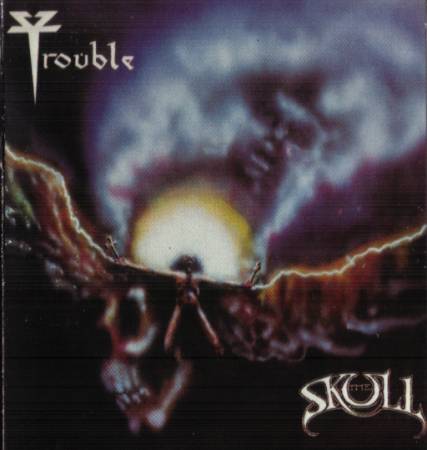
In addition to being bummed about not having my ’81 B.C. Rich Seagull to record with, I was kinda nervous. Consider this: it was my first real recording studio experience. Nervousness led me to press down too much on the fingerboard. In effect trying too hard. Not good for keeping notes to correct pitch whether you’re technically in tune or not! Humidity likewise made my guitars go out of tune and misbehave. A gargantuan PA blared Dan and Brian’s tracks at me. I tell ya folks, I was frustrated and freaking out for a bit. I didn’t freeze up by any means, yet I wasn’t too thrilled with punching in a lot more parts than I originally expected. Perhaps that irked Bill some. Unlike other producer/engineers I’ve recorded with, Bill Metoyer isn’t a musician, so I’m not sure if he can see things from our creatively eccentric perspective. On the other side of the coin, I was relatively young and it was a valuable experience to be somewhat humbled in the studio. Bill’s been involved in a lot of historically important metal albums, and I suppose I’d have to say I worship the bands and albums he worked on more than I do the actual sound of said slabs like Fates Warning’s Awaken the Guardian (1986) or Trouble’s The Skull (1985). I dug hanging out with Bill, his sense of humor, the way he seemed dedicated to our project. But if I were to compare the Breathe Deep the Dark sessions to any other studio experience I’ve had, it would have to be the worst. Certainly I enjoyed everything about working with engineer/co-producer Joe Floyd more on our Transition album. Joe is a guitarist, and he brings a wealth of musical knowledge to the table. Likewise, his studio is chock full of amazing professional gear both vintage and modern. I’m not just considering the hodge-podge studio setup of Bill’s Place here. It was the whole Bill’s Place debacle, ya know? A cyclopean Sunn PA shrieking at you while tracking. Being spread out in different rooms across a big building. How ‘bout the nearly inaudible bass guitar? All elements that smack of an expensive demo rather than a serious debut album.
Steel Prophet bassist Vince Dennis worked at Bill’s Place and also teched for Fates Warning on the side. Vince offered me the use of his white B.C. Rich Gunslinger bolt-on. He’d gotten the Gunslinger off Fates Warning’s Jim Matheos when Jim switched to Paul Reed Smith. I wasn’t too comfortable with Jim’s axe, though it would’ve been an honor to use gear that once belonged to one of my fave metal guitarists of all-time. Anyhow, I buckled down and got to work with only the use of my 1983 B.C. Rich Warlock, 1980 B.C. Rico Mockingbird (a rare Jap neckthru) and 1992 Jackson Rhoads Pro (also a Jap neckthru, formerly owned by Prong’s Tommy Victor). Problems struck with the licensed Floyd Rose trem system on the Jackson. The Floyd went completely out of whack, buggering the action (string height for you non-musicians) and intonation. Ed Laing reminded me to stretch my strings thoroughly every time I changed ’em, but that still didn’t alleviate the Jackson issue. I fought the frustrations and ultra-fast tempos, but “Rebirth” and “To Be Immortal” were taking too long to track, so I caved at the suggestion of Dan taking over to record another set of rhythms for only those two. They were Dan’s songs, so he obviously had an easier time. Where there were harmonies or a varying second guitar part I had to show Dan exactly what I was playing differently in those two. Dan and I kept a watchful ear on Nardo laying down his bass. He needed a lot of coaching through notes to make sure he wasn’t playing out of key. Nardo’s right hand (pick) fingers were pretty fast, but his left required help. As in what note to hit when. Even with all this attention to detail we realized after the album was released that Dan was actually playing a note in the verse of “Fortress” a half step lower than I wrote and played my part. It’s played so blindingly fast that I doubt even the most anal retentive musician could tell.
When James showed up in L.A. during mixdown, he sniped at me. “Why didn’t you just let Dan track all the rhythms. You took too long. Andre [Corbin] let Larry [Barragan] do it in Helstar. Andre didn’t give a shit about anything but his solos.”
“Well,” I countered (this isn’t exactly word for word), “I care about my rhythms, ya know? Andre was a lead man. I’m not trying to be Mr. Yngwie von Shred. I write songs.”
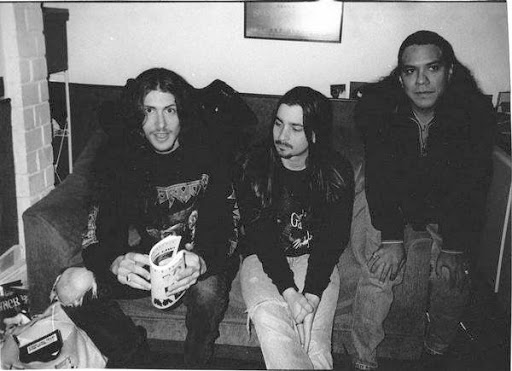 |
| Perry, Dan and James at Bill's Place while mixing Breathe Deep the Dark |
DE was not a situation like the first several Metallica albums where James Hetfield cut layer upon layer of rhythm guitar by himself and left Kirk Hammett only his solo overdubs. Especially for “Breathe Deep,” “Fortress” and “The Obscure” to be heard correctly, my rhythm playing was required. Since the tunes were written with my personal idiosyncrasies, only I knew them to a “T.” I’m a reasonable guy, so I didn’t sit there and bitch forever about the fact that I should’ve been the first guitarist to track rhythms for the songs I contributed to DE. It is, without a doubt, harder to match an existing rhythm than record the initial one. So, I’m not overly bothered that those two DeLucie tunes only have my lead work on them. The 8 remaining songs are an equal split 50% Dan and 50% me for two rhythm guitar tracks on each side.
Truthfully, I didn’t lag overly much on rhythms save for those last two tunes of Dan’s. James got away Scot-free with the production of his vocals on Breathe Deep by comparison to the scrutiny of my rhythm guitar tracks. Instead of hearing Dan and I asking him to punch in a part he sang out of key or flat, all James had to worry about was finishing early so he and Bill could hit the Houston titty bars. He didn’t have any of us present in Texas to ride him about whether he was flat, sharp or even in the right ballpark key-wise over a certain riff.
 |
| The Decline 'n' Fall! |
Bill’s Place was a hive of activity while DE encamped for the Breathe Deep sessions. W.A.S.P., Steel Prophet and Fates Warning were rehearsing upcoming gigs or tours. One day I showed up early to the studio to find the place locked. Every metalhead’s fave Decline of Western Civilization II character, Chris Holmes, was waiting in the back lot. I parked next to his Frankenstein graphic white Chevy Camaro and tried to make small talk. Unlike some of the “legends” at the ’97 Metal Blade Xmas bash, Holmes actually spoke—a breath of fresh air! Holmes’ guitar amp was so loud that we often head him down the hall above the rest of W.A.SP. Affable Vince Dennis showed up after a spell and let us in. We saw Vince nearly every day. Sometimes he’d be joined by Steel Prophet axeman Steve Kachinsky. Vince and Steve were always very outgoing and friendly towards us, even when we shared the stage a few times in Socal and Germany. A brotherhood rather than a lame competition! While I was finishing up my rhythms, Flotsam and Jetsam drummer Craig Nielsen turned up. He walked down the hall and peeked into the “guitar room,” thinking there was a band rehearsing—with all that PA thunder. He didn’t realize I was tracking. Though I was neck-deep in my rhythms, I didn’t cop a ’tude or yell at him to leave. Believe it or not, I took a minute to say “Hey!” and explain what was happening. We regularly saw Craig everywhere around SoCal, while his bandmates lived in AZ. Craig was always keen to chat and was the Flotz dude I most bonded with. Flotsam and DE played together at the infamous Reseda Country Club to celebrate the release of Breathe Deep and the forthcoming Flotsam disc Unnatural Selection.
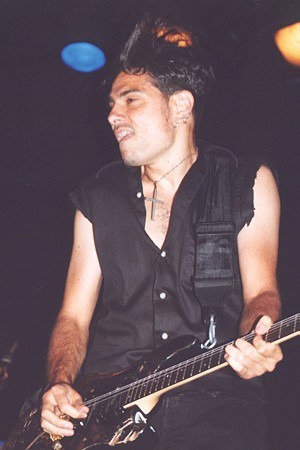 |
| Steel Prophet axeman Steve Kachinsky |
 |
| Steel Prophet bassist Vince Dennis |
It was common to catch Mark Zonder in the wings of Bill’s Place. After all, he owned the place.
 |
| Warlord - Deliver Us |
Remember, folks, DE was very much a melodic ’80s type prog/power metal band. On a personal level, I not only worshiped Fates, but Zonder’s previous band, Warlord. In my book, Warlord’s Bill “Destroyer” Tsamis was a purveyor of some crazily catchy riffage, heavily spiced with Greek melodies and tasty leads. To the point that I thanked Warlord in my Breathe Deep liner notes! Listen no further than the bridge of “Breathe Deep the Dark” to hear how much Warlord was an influence on me personally. I guess Zonder had “grown out of it.” It’s safe to say that I’ll never be too old to appreciate Warlord.
 |
| Rob Garven (Cirith Ungol) |
The last thing that we tracked before mixing began was clean-tone and acoustic guitars. Dan had a cheapie Washburn and I still owned this shite Applause roundback, a godawful entry-level version of Kaman’s flagship Ovation acoustic line. I remember the last thing I laid down was the clean electric intro to “Idle City/The Fortress Unvanquishable.” It required nearly absolute silence in a busy rehearsal facility. We were also agonizingly close to both Van Nuys and Burbank airports that planes overheard were killing the early evening session. Bill and I had to wait a while for Gary Gnu-nuers Spineshank, complete with their massive rehearsal budget, to stop playing in the room next door —not to mention the planes to die down. I was mildly vindicated in playing my beloved blue ’81 B.C. Rich Seagull for that itty-bitty clean part. We felt very accomplished with all tracks “in the can.”
Double or Nothing: Mixing, Mastering and Low-End Lameness
Mixing Breathe Deep took ages. Bill Metoyer finished a first mix within a couple of weeks. Dan and I were present every day too, but Metal Blade balked at it. Brian Slagel took it upon himself to guide Bill through a second mix. Again, Dan and I were at the studio every day to voice our opinions, explain what effects were needed where/when and to make sure no important tracks were omitted. I kept emphasizing how I loved the ultra-wet and slick sound of Andy LaRocque’s solos. We even exhaustively delved through Bill’s library of sound effect CDs to pick a few to use in song intros.
We had plenty of contact with Mike Faley, but it wasn’t until Slagel came down to remix that I was fully acquainted with the MB CEO. Slagel and I got along like a house on fire from day one in the studio. I babbled incessantly about cult metal bands. Slagel asked me what the hell “unvanquishable” meant. I had to tell him it was a synonym for invincible.
A silly little Fates/Metal Blade anecdote: I told Bill Metoyer that Awaken the Guardian was probably my fave album he engineered. In rambling about the Fates disc and John Arch’s distinctive voice and idiosyncratic (but nonetheless killer!) lyrics, I started talking about the final song, “Exodus.” Bill cracked a wicked grin and said, “You know Slagel still thinks he sings, ‘Exodus ice on the plain' in the chorus on that one.”
“Yeah, but… uh… it’s ‘ascend the plane.’”
Dan and I loved the trippy phasing effect in the fade-out at the close of Fates’ “Exodus” so much that we instructed Bill to do something similar with the end of “Where Do We Go” on Breathe Deep the Dark.
During Slagel’s mixing stint at Bill’s Place repeatedly asked him to tell me about the days of yore or just got his opinion on Cirith Ungol, Fates, Trouble, Warlord, Torch, Candlemass, Diamond Head, Thin Lizzy and the like. I’m sure I mentioned my Pentagram mania, and I don’t recall Slagel being the least bit interested. All considered, Slagel was affable towards me and the DE guys, and he promised to hook me up with a bunch of classic Metal Blade vinyl that was missing from my collection.
In hindsight—which I’ll remind you is always 20/20—Slagel’s presence further sucked the bass guitar right out of Breathe Deep. That’s not a reflection on how we initially bonded with Slagel. It’s just sonically speaking. There are several isolated spots when you can hear Nardo’s bass, but those are largely the “solo” sections on “Unsolved World” and “Under Destruction’s Thumb.” Dan and I were too awestruck and caught in the heat of the moment to voice our concern about Nardo’s buried bass. We learned our lesson though, making sure to speak up about the importance of bass with engineer Joe Floyd during the Transition sessions. The result? A warm, fat bass tone and presence that cut through in even the thickest sections of guitar. The Transition budget also allowed me and Dan to be present while James tracked his Transition vocals. On the quality-control side of production, that was something we were especially keen on. On a personal level, it meant being around the cause of much internal strife in the DE fold. Transition was still in DE’s future, so I now return you to your regularly scheduled Breathe Deep broadcast.
We wasted nearly an entire day combined on a song which was left unfinished during the Breathe Deep sessions. Nardo brought about 50% of a tune in towards the end of ’97, calling it “Symbol of the Soul.” I helped him finish it, but none of us liked the title or the lyrics James wrote. I toyed around with an alternate set of lyrics, "Demise of a Lie,” but it suffices to say neither set of lyrics would've flown in DE. James’ was too religious. The other anti-religion. If my memory hasn’t completely Swiss-cheesed, we never demoed “Symbol.” At Bill’s Place we actually tracked drums, rhythm guitars and bass, then abandoned it. Truly a “lost” DE track! I’m not even sure if it is on the multi-track ADATs or if said tapes exist any longer. What does exist in terms of Breathe Deep rarities is “Thief of Life,” which we meant to be our Japanese bonus track.
Breathe Deep wasn’t just mixed twice. It was mastered twice. Overkill? Slightly! Once at Future Disc by Tom Baker (no, not the Dr. Who actor), then after Slagel decided he didn’t like the job he handed it to Eddie Schreyer at Oasis . (Going over budget on mixing and mastering inevitably meant DE would have insanely hefty “recoupables” to surmount before Metal Blade would ever even entertain the thought of paying mechanical royalties to us. Non-existent “mechanical royalties” is a better term, I’d say.) I was there on both occasions, so were Dan and Slagel. I was exceedingly involved with each step of the album’s production, striving for a polished and professional approach. Hell, you might even call my preoccupation with recording anal retentive. That’s fine by me. The Breathe Deep master cassettes made the jump with me across the globe from SoCal to Sydney. I actually ripped the studio version of “Thief of Life” directly from the Oasis master cassette in 1999 while I was still residing in ye olde San Fernando Valley.
Aliens, Hearses and Eccentric Lensmen
 |
| A rare parking lot shot in Slimy (I mean Simi) Valley, CA |
 |
| Angus Scrimm, Phantasm's Tall Man, goes balls out! "You play a good game, boyyyyy!" |
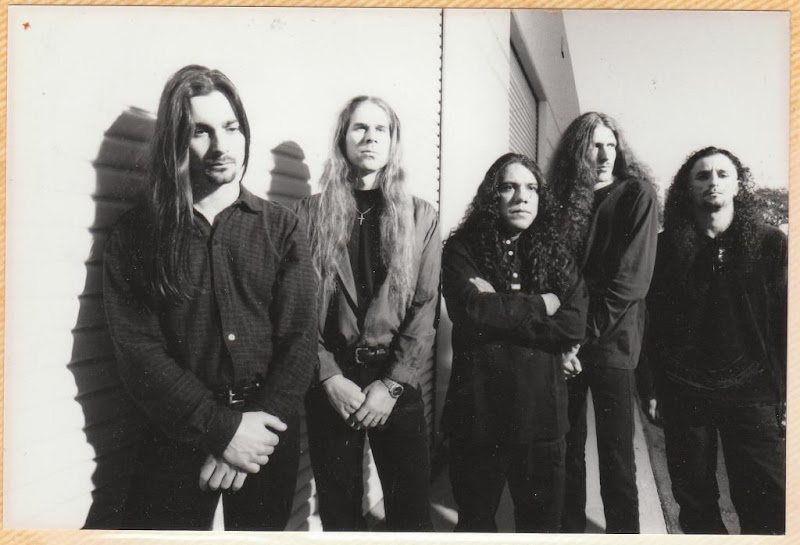
Lensman Alex Solca was hired to shoot Destiny’s End photos for the Breathe Deep the Dark packaging and promo material. Alex is a spritely artistic and eccentric chap who drives a hearse and is extremely passionate about his photography. Alex got some spiffy shots of us at the Metal Blade warehouse, including one of us with a blue broken glass gel overlay (which was used as our European 3x5 promo glossy). We had our guitars and took some individual shots too (which have never seen the light of day). Then, at my suggestion, we did a second photo shoot—this time at night. Stoney Point, near the northern edge of Chatsworth and Santa Susana Pass, was the location I had in mind and heart. The DE guys and Alex were eager to use the place based on my description. We drove out at night, with only sparse moonlight to guide us. Alex roared along in his gray Cadillac hearse. I half expected Angus Scrimm (The Tall Man from Phantasm) to pop out of the machine when we stopped. Or a brown-robed dwarf zombie from the coffin bed instead of the tripod and lighting rig. Stoney Point is a massive mound of boulders perched on the south side of the 118 Freeway on the borderland between Simi Valley and Chatsworth. I haunted the hilly area throughout my teens and into my 20s. Far more appropriate to our ominous album title, band name, lyrics and general ethos! While we wanted to appear austere, we were anything but. Nardo kept saying that Alex’s multicolored lights must seem like aliens to hikers in the distance. Sure enough, a couple of intrepid climbers stumbled upon us.
 |
| The Tall Man and his Caddie in Chatsworth Park |
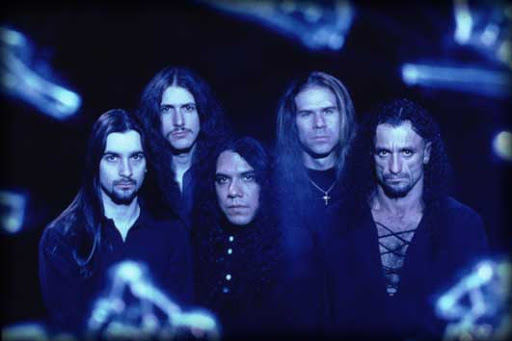 |
| The trippy blue gel and shattered glass overlay shot! |
 |
| Photographer extraordinaire Alex Solca |
“Greetings Earthlings! Take me to your leader.” I exclaimed.
Nardo had just watched Tim Burton’s Mars Attacks and started mimicking the Bug-Eyed Monsters, “Hat-hat! Hat-hat-hat!”
 |
| Destiny's End 8x10 promo glossy by Alex Solca - 1998 |
 |
| Color shot from Stoney Point, Chatsworth, CA |
Our 8x10 U.S. promo glossy was our favorite of the close-knit group shots, while our one-sheet album poster pictured us perched on a massive Stoney Point boulder. I was seated with my hands folded, my eyes staring off in the distance as if contemplating the riddles of life, death and the universe. I can joke about it now, but I probably was experiencing deep thoughts. Alex developed both shoots as 35mm chromes (slides), and we borrowed them from Metal Blade to make our selections. A reflection on how dedicated to every aspect of the band and album we were: Dan brought a slide projector down to our rehearsal room, and we sorted through pix on a white sheet pinned to the soundproofed wall.
 |
| Destiny's End contemplating the ultimate riddles of the cosmos at Stoney Point |
 |
| Overexposed b&w shot from Slimy Valley |
 |
| Another overexposed shot from the Breathe Deep sessions with Alex S. |
The album cover was another final item that required our attention. We settled on using German artist Rainer Kalwitz for our cover. We were aware that he’d done some stunning covers for other metal bands, and he was well within our artwork budget. Since the few existing pieces Rainer had for sale didn’t suit us, we commissioned him to come up with an original painting based on the lyrics to my tune (our title track) “Breathe Deep the Dark.” Rainer faxed us simple storyboard sketches of his cover and a second painting of the five DE members—like stick figures nearly. Fortunately Rainer is better at painting than storyboarding, and the final result blew us away. Well, Nardo and Brian thought they looked a bit cross-eyed in the tray card painting, but otherwise… The layout was tackled by Metal Blade’s usual guy, Brian Ames. I typed and proofread the text for our booklet. Dan and I regularly spent tons of time on the phone at our respective jobs conducting band business. Faxes and emails jumped back and forth. Dan and I pestered Brian with heaps of small corrections. For the most part the CD packaging turned out better than expected, especially the retrofit of the DE logo. The logo was originally rendered by Dan’s work pal. Our promo glossy suffered from a pixelated low-res scan of the DE logo and our one-sheet poster logo was also a tad blown-out. Because I was working in the graphic design, packaging and advertising field, I thought it looked shoddy, especially considering Metal Blade was supposed to be a highly respected big indie metal label. Frankly, we paid more attention to detail and were consistent with print resolution at my old job (primarily smut biz clients!) than MB was with the DE promo pic and poster.
 |
| Rainer Kalwitz's full Breathe Deep the Dark painting based on my lyrics - 1998 |
 |
| Inside traycard - Rainer Kalwitz's paint rendering of the DE members' faces - 1998 |
 |
| Solo Perry shot by Alex Solca |
 |
| Perry, Nardo and James at Club 369, Fullerton, CA |
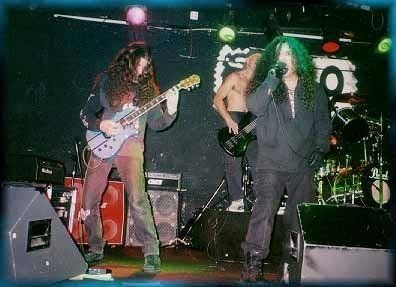
Several months elapsed after Breathe Deep was finished before it was released. In the interim we played our first triumphant gig at Cardi's in Houston, TX (March ’98). Then a bummer show in Corpus Christi the next day. Our super cool SoCal debut was at Club 369 in Fullerton, CA, in April ‘98. Our album release gig with fellow Metal Bladers Flotsam and Jetsam occurred in September at the Reseda Country Club, the venue where I saw my very first local thrash/death metal gig at 15. Although I was working a “day job,” I was pretty much floating on Cloud 9 as far as DE was concerned. I was finally happy to be in a band that was recording and gigging professionally. Just because we were signed
Read more
Read more
Historical external sources
These links preserve the original historical URLs. Each source also has its own Wayback Machine wildcard archive link.
 Falcon official website News
Original: http://www.falconband.net/falconnews.htm
Wayback: Wayback Machine
Falcon official website News
Original: http://www.facebook.com/pages/Falcon/46240628044
Wayback: Wayback Machine

 Cirith Ungol Group @ Facebook
Original: http://www.facebook.com/home.php?sk=group_2395730753
Wayback: Wayback Machine
Cirith Ungol Group @ Facebook
Original: http://www.facebook.com/group.php?gid=2395730753
Wayback: Wayback Machine
Cirith Ungol Like Page @ Facebook
Original: http://www.facebook.com/pages/Cirith-Ungol/109421575742492
Wayback: Wayback Machine

 CDandLP search
Original: http://www.cdandlp.com/liste/?lng=2&srt=relevance&what=artiste&tete=cirith%20ungol&affilie=media
Wayback: Wayback Machine
 Amazon.com search
Original: https://www.amazon.com/s?k=Cirith+Ungol&linkCode=ll2&tag=media01e-20&linkId=a1081c47c098f8f19db8e33b2a45728f&language=en_US&ref_=as_li_ss_tl
Wayback: Wayback Machine
 CD Universe search
Original: http://www.cduniverse.com/browsecat.asp?style=music&cat=58&frm=lk_cirithungol
Wayback: Wayback Machine
 Metal Fighters search
Original: http://affiliates.metalfighters.com/jrox.php?uid=thedani&jxURL=http://www.metalfighters.com/shop/advanced_search_result.php?keywords=Cirith+Ungol
Wayback: Wayback Machine


 The Angry Samoans @ MySpace
Original: http://www.myspace.com/angeredsamoans
Wayback: Wayback Machine


Historical Facebook


Today:
► Sat 28.Nov 2026
►Updates
►The True Metal Force (disabled)
►Official Homepage (archive)
►Comprehensive resource for CU
►Stats database (disabled)
► Sat 28.Nov 2026
►Updates
►The True Metal Force (disabled)
►Official Homepage (archive)
►Comprehensive resource for CU
►Stats database (disabled)
Vision
►NOT to be the most comprehensive and most awesome resource for Cirith Ungol. Disabled from 2015.
►NOT to be the most comprehensive and most awesome resource for Cirith Ungol. Disabled from 2015.
Contact:
►Webmaster
info [at] cirithungol [dot] org
►Webmaster
info [at] cirithungol [dot] org