(IT) • Zine Classix Metal • Issue N. 2 • Journalist
Salvatore Fullucca
• Language Italia • Published (unknown date) Apr 2009
(IT) • Zine Classix Metal • Issue N. 2 • Journalist
Salvatore Fullucca
• Language Italia • Published (unknown date) Apr 2009 - 🚀 Copy short link
- 🔙 Back to Media
- « The New Heavy Metal Revue – Number Six | Rock Hard #297 »
- ⚠️ Add, Edit or Remove your item
- 🗺️ Old Cirith Ungol Webpit
- 🔍 Classix Metal #2 April 2009 ( WP search or FB )
Classix Metal #2, April 2009. Italian metalzine.
-

- page 1

-

- page 54
-

- page 55
-

- page 56
-
- page 57
-
- page 58
-

- page 59
-
- page 60
Thanks to the article writer Salvatore Fallucca for sending me this!
Most of them are translated to English:
(page 54):
Lyrics by: Salvatore Fallucca
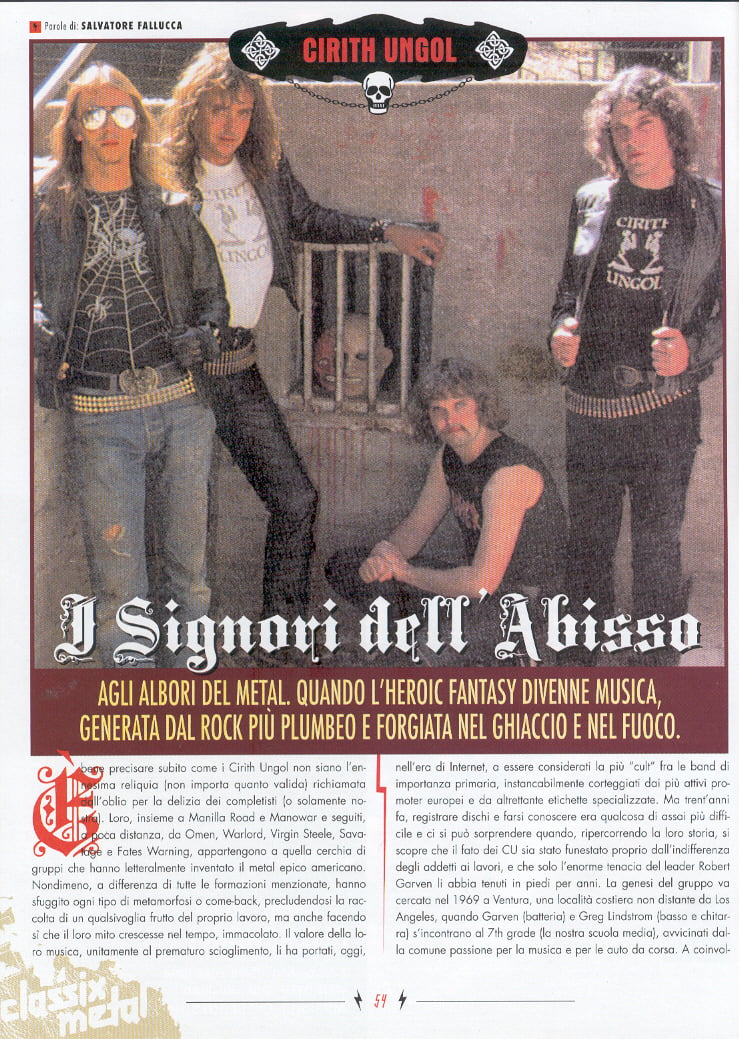
The Lords of the Abyss
At the dawn of metal, when heroic fantasy became music, born from the heaviest rock and forged in ice and fire.
It must be said right away that the name Cirith Ungol has remained a sort of sacred relic, no matter how valid the label “forgotten” may be for the delight of completists. They alone, together with bands like Manilla Road and Manowar, and followed at some distance by Omen, Warlord, Virgin Steele, Savatage and Fates Warning, belong to that circle of groups that literally invented American epic metal.
However, unlike all the aforementioned bands, they avoided any kind of transformation or comeback, precluding the exploitation or exclusive reuse of their image, but also ensuring that their myth grew over time, untarnished. The value of their music, together with their premature breakup, has carried them—today, in the age of the Internet—to be considered the “cult” band of primary importance, constantly celebrated by ever more specialized publications and labels.
Yet thirty years ago, recording albums and making oneself known was something far more difficult, and one can be surprised, retracing their story, to discover that fate left them sidelined due to the general indifference of industry insiders—if not for the enormous tenacity of leader Robert Garven, they would have been buried long ago.
The band was formed in 1969 in Ventura, a town not far from Los Angeles, when Garven (drums) and Greg Lindstrom (bass and guitar) met in 7th grade (middle school), bonding over their shared passion for music and car racing.
(page 55):
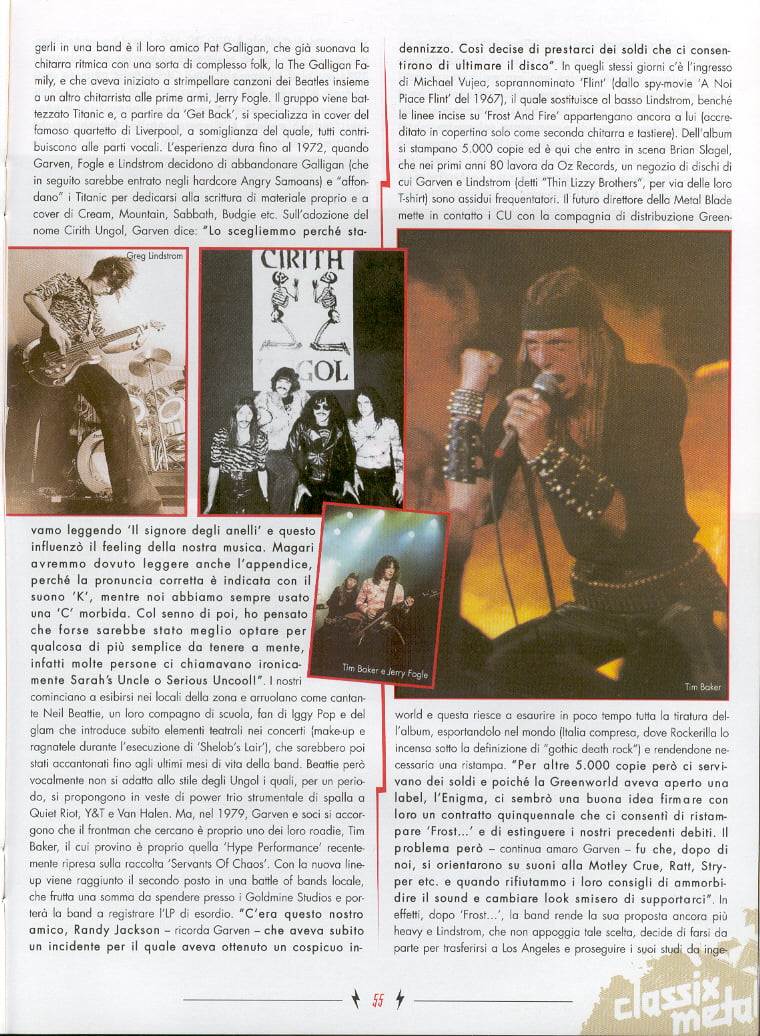
The band also included their friend Pat Galligan, who had already played rhythm guitar in a folk-inspired group, The Galligan Family, and who had started playing Beatles-style pieces together with another early guitarist, Jerry Fogle. The group was initially called Titanic and, apart from “Get Back,” specialized in covers of the famous Liverpool quartet, to whom Fogle also contributed vocals.
The experience lasted until 1972, when Garven, Fogle, and Lindstrom decided to part ways with Galligan (later replaced for a short time by Argus Samosan) and move beyond Titanic to focus on writing original material, alongside covers of Cream, Mountain, Sabbath, and Budgie.
With the adoption of the name Cirith Ungol, Garven said:
“We chose it because we were reading The Lord of the Rings, and that influenced the feel of our music. Maybe we should have read the appendix too, because the correct pronunciation uses a hard ‘K’ sound, while we always used a softer ‘C’. Looking back, it might have been better to choose something simpler to remember—many people jokingly called us ‘Sarah’s Uncle’ or ‘Serious Uncool’.”
Their early shows took place in local dance halls, where they recruited singer Neil Beattie, a schoolmate of theirs, a fan of pop and glam, who introduced subtle theatrical elements into their concerts (makeup and stage antics during “Shelob’s Lair”), which would later be dropped in favor of a more direct style. Beattie’s vocals didn’t really suit the band’s style, so for a time they considered shifting toward trends inspired by Quiet Riot, Van Halen, and similar acts.
In 1979, Garven and his bandmates realized they needed a stronger frontman, and Tim Baker arrived—bringing exactly that “high-performance” vocal style that had already been appreciated on recordings like “Servants of Chaos.” With the new lineup, they achieved second place in a local battle of the bands, earning enough money to record their first demo at Goldmine Studios, thanks to a friend, Randy Jackson. Garven recalls that Jackson had just received a large insurance payout after an accident and decided to lend them the money to finish the record.
Around that time, Michelle Vela joined as a soprano vocalist (she appears on “Frost and Fire” and “A Little Piece of Hell ’76”), while Lindstrom switched to bass, even though the credits still listed him as guitarist. The album sold around 5,000 copies, and from there Brian Slagel entered the picture, who in the early ’80s worked at Oz Records, a record shop frequently visited by Lindstrom (a Thin Lizzy T-shirt was his daily uniform).
The future head of Metal Blade Records then connected the band with the Greenworld distribution company. Greenworld managed to sell out the entire pressing in a short time, exporting the album worldwide. Thanks to this success, the band came close to being classified under the emerging “gothic death rock” label, prompting a reissue.
However, despite another 5,000 copies sold, things didn’t go as expected. Greenworld offered them a five-year contract to reprint “Frost and Fire” and pay off previous debts. But—Garven bitterly recalls—after that, the label began pushing them toward a more commercial direction, influenced by bands like Mötley Crüe, Ratt, and Stryper. When they refused to soften their sound or change their image, the situation became difficult.
Indeed, after “Frost…,” the band had proposed a heavier direction, but Lindstrom disagreed and eventually left to move to Los Angeles and continue his studies in sound engineering.
(page 56 and 57):
(page 56): Garven comments on the matter:
“Greg began to be influenced by the new wave and the split was essentially a matter of taste. Moreover, he had never been a fan of Tim and tried to replace him, believing his vocal style wasn’t commercial enough. We, on the other hand, decided to stick to our path even more firmly. I’ll tell you more: even with Frost and Fire we had tried to be as commercial as possible, at least in our view, but we only got very limited radio exposure, because everyone said we were too heavy. So we decided to stop holding back and show something that was truly heavy.”
In 1982, Cirith Ungol were included in the compilation Metal Massacre Vol. II, featuring the thunderous “Death of the Sun,” which anticipated the direction of their second album. However, due to budget constraints, they had to wait until 1984 to record King of the Dead, released in Europe by Roadrunner Records.
Speaking about that album, Garven himself emphasized:
“Undoubtedly it is our best work, because we had total control over the ideas.”
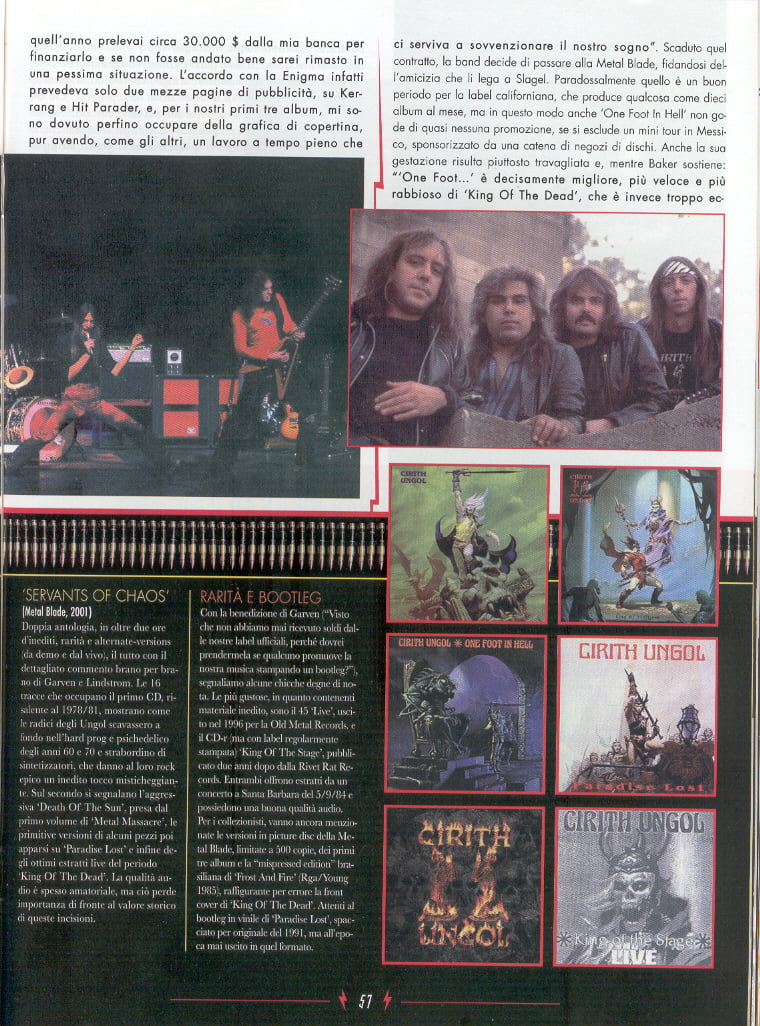
(page 57): “In that year I withdrew about $30,000 from my bank to finance it, and if things hadn’t gone well it would have been a terrible situation. The agreement with Enigma actually only covered half of the advertising costs, so Kerrang! and Hit Parader, and for our first three albums, I even had to take care of the cover artwork myself, despite already having a full-time job that barely allowed me to support our ‘dream.’
Once that contract expired, the band decided to move to Metal Blade, strengthening the friendship that ties them to Slagel. Paradoxically, that’s a good deal for the Californian label, which releases something like ten albums a month, but in this way One Foot In Hell doesn’t get almost any promotion, except for a few tours in Mexico, supported by a chain of record stores. Even the album’s distribution is rather troubled, while Baker claims:
‘One Foot… is definitely better, faster and more aggressive than King Of The Dead, which was instead too…’”
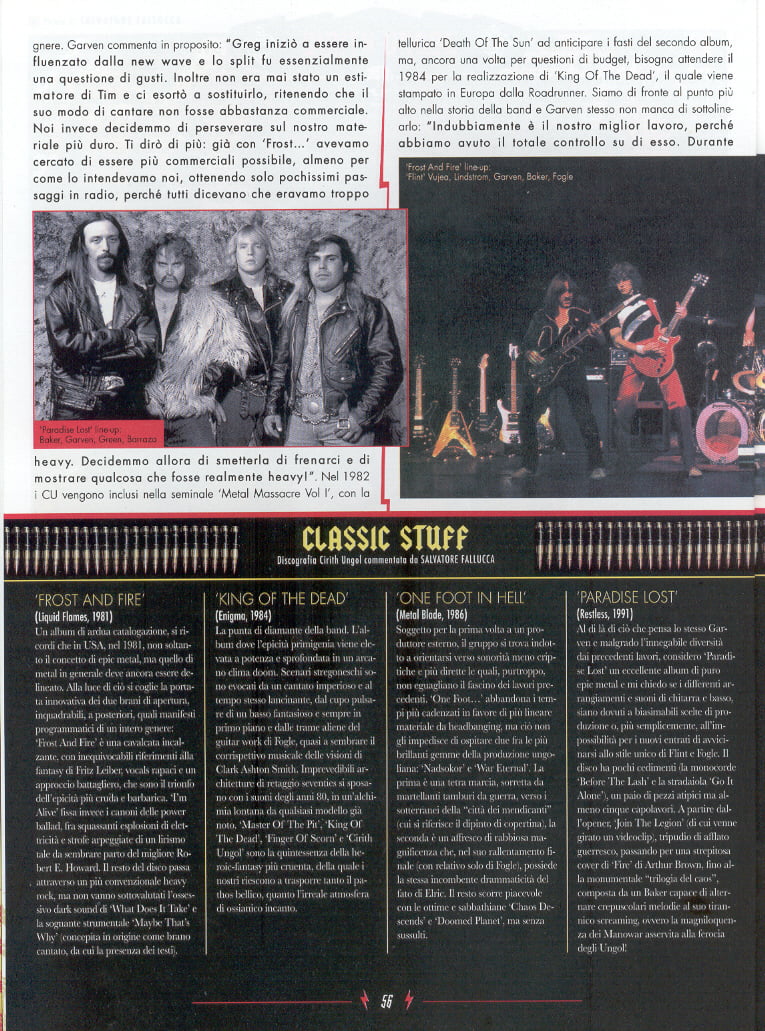
(page 56): CLASSIC STUFF
Cirith Ungol discography, commentary by Salvatore Fallucca
Frost and Fire (1981)
(Liquid Flames)
A difficult album to categorize, released in the U.S. in 1981—not only the year of metal’s birth as we know it, but also the year of its death…
Somewhere between heavy metal, progressive rock, and epic atmospheres, Frost and Fire is an unstoppable ride that anticipates many future directions. Tracks like “What Does It Take” and “Maybe That’s Why” show surprising stylistic variety.
King of the Dead (1984)
(Enigma)
The absolute peak of the band. A work where epic metal reaches a unique expressive power.
Songs like “Master of the Pit,” “King of the Dead,” and “Finger of Scorn” define the epic metal style, combining dark atmospheres, dramatic vocals, and powerful riffing.
One Foot in Hell (1986)
(Metal Blade Records)
A partial shift toward more melodic and accessible structures, without losing the band’s identity.
Tracks like “Blood & Iron” and “Chaos Descends” still maintain strong intensity, even if the production is cleaner and more polished.
Paradise Lost (1991)
(Restless)
An ambitious and controversial album.
More structured and progressive, it moves further away from raw epic metal. Songs like “Join the Legion” and “Before the Lash” highlight a darker, more complex direction, though not all fans appreciated the change.
(page 57): SERVANTS OF CHAOS
(Metal Blade, 2001)
“Double anthology, with over two hours of music, including 4 live tracks and a demo recording, all thoroughly documented with comments by Garven and Lindstrom. The 16 tracks, taken from the first CD, dating back to 1978/81, show how the roots of Ungol can be traced back to a somewhat more psychedelic approach of the late ’60s and early ’70s, blending blues contaminations. The second CD collects the ‘ragged’ demo of Death Of The Sun, taken from the first volume of Metal Massacre, the primitive versions of some tracks later appearing on Paradise Lost and finally others taken from the King Of The Dead period. The audio quality is often amateurish, but that matters little compared to the historical value of these recordings.”
RARITIES & BOOTLEG
“With Garven’s blessing (‘since we didn’t receive anything from the record companies, I think it’s right to take advantage of something that promotes our music, making us known better’) we point out some unofficial releases worthy of note. The most interesting, as it contains previously unreleased material, is 4½ Live, released in 1996 by Old Metal Records. There is also a nice bootleg CD called King Of The Stage, released a couple of years ago by Riot Act Records. Both come from a concert in Santa Barbara on 3/5/84 and have good audio quality.
For collectors, there’s also the Metal Blade version of King Of The Dead, limited to 500 copies, the first 100 of which were misprinted with the cover of the Brazilian compilation Frost And Fire (Raga/Voyage 1985), mistakenly showing the front cover of King Of The Dead. Also beware of the Paradise Lost vinyl bootleg, passed off as an original from 1991, but it never actually came out in that format at the time.”
(page 58):
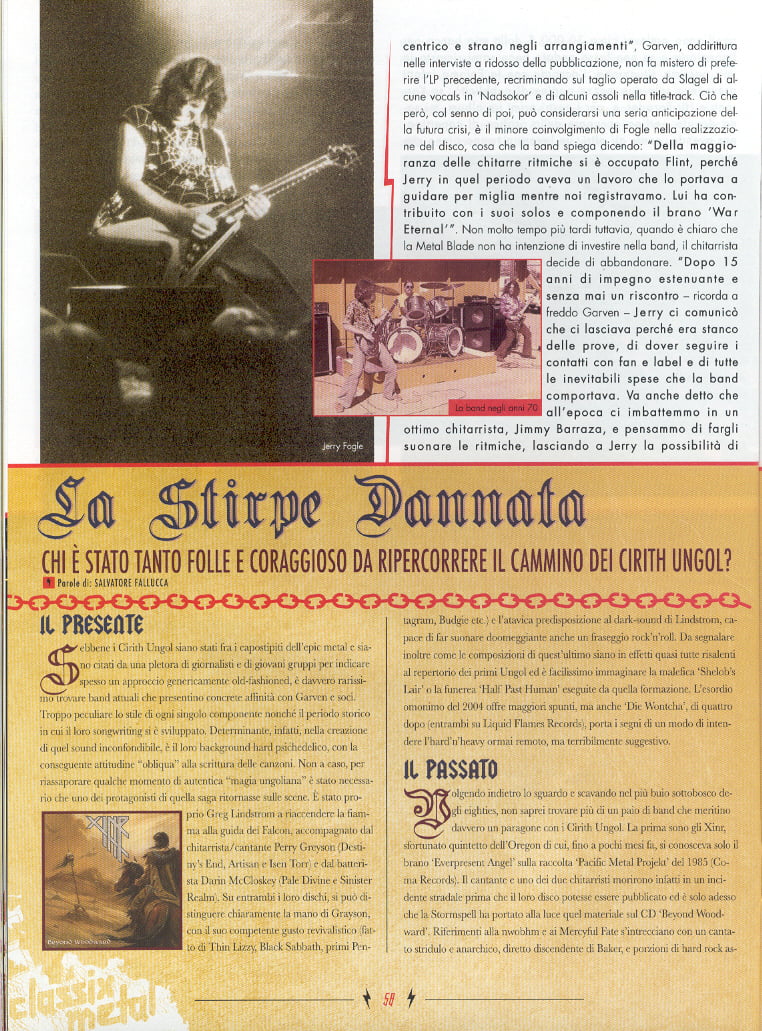
“…eccentric and unusual in the arrangements,” Garven says, even in interviews released around the time, somewhat mysteriously preferring the previous LP, criticizing the cuts made by Slagel to the vocal parts in Nadsokor, some of which are single takes. Which, however, cannot be considered more than a hint of the future crisis and the lesser involvement of Fogle in the making of the album, something the band explains by saying:
“Most of the rhythm guitars were handled by Flint, because at that time Jerry had a job that required him to drive for miles while we were recording. He contributed his solos and also composed the track ‘Woe Eternal’.”
Not long after, however, it became clear that Metal Blade had no intention of investing in the band, and the guitarist decided to leave.
“After 15 years of effort without ever seeing any return,” Garven recalls coldly, “Jerry told us he was leaving because he was tired of rehearsals, of having to manage contacts with fans and the label, and all the inevitable expenses the band involved. He also said that at the time we met an excellent guitarist, Jimmy Barraza, and we thought about having him play the rhythm parts, leaving Jerry the possibility of—”
The Damned Lineage
Who has been crazy and brave enough to follow in the footsteps of Cirith Ungol?
Words by Salvatore Fallucca
THE PRESENT
Although Cirith Ungol are among the pioneers of epic metal and have been cited by a multitude of today’s young journalists and fans of various groups as a clear example of anti-fashion integrity, it is truly rare to find modern bands that concretely present affinities with Garven and company.
Too peculiar is both their musical style and the historical period in which their sound developed. Crucial, in fact, in the creation of that unmistakable sound is their psychedelic hard rock background, combined with a more blues-based structure and songcraft. It’s no coincidence, then, to rediscover moments of genuine “Ungolian magic” in the more underground scenes of recent years.
Among the most notable of those carrying that flame forward is the Swedish band Falconer, led by former Mithotyn guitarist/singer Per Tyrsson (a.k.a. Per Gryphon). Destiny’s End draws inspiration from them, as do the Texans Twisted Tower Dire and the band featuring Dan McCloskey, Divine & Sinister Realm. Across all their albums, one can clearly detect the hand of Gryphon, with his refined taste in revisiting the styles of Thin Lizzy, Black Sabbath, and Budgie, along with Lindstrom’s marked inclination toward darker tones, which lends these bands a “retro” edge.
Naturally, compositions of this kind are often rooted in the early years of Cirith Ungol, and it’s easy to imagine the influence of albums like Frost and Fire or King of the Dead. Records such as Shadows of the Past (2004) offer further inspiration, while The Witches (on Liquid Flames Records) retains a more traditional imprint, though still evocative.
THE PAST
If one looks back and digs into the darker corners of the late ’80s, it’s not easy to find more than a couple of bands that truly deserve comparison with Cirith Ungol. The first is the unfortunate quintet Othorgin, who in just a few months managed to become known for a single track, Everpresent Anger, released by the label Pacific Metal Project in 1985. Sadly, the singer and one of the guitarists died in a road accident before their album could be released, and only recently has Stormspell Records made the material available as Beyond Woodward.
Stylistically, they fit within the realm of Mercyful Fate, featuring a shrill and anarchic vocalist clearly influenced by Tom Baker, along with traces of more classic hard rock…
(page 59):
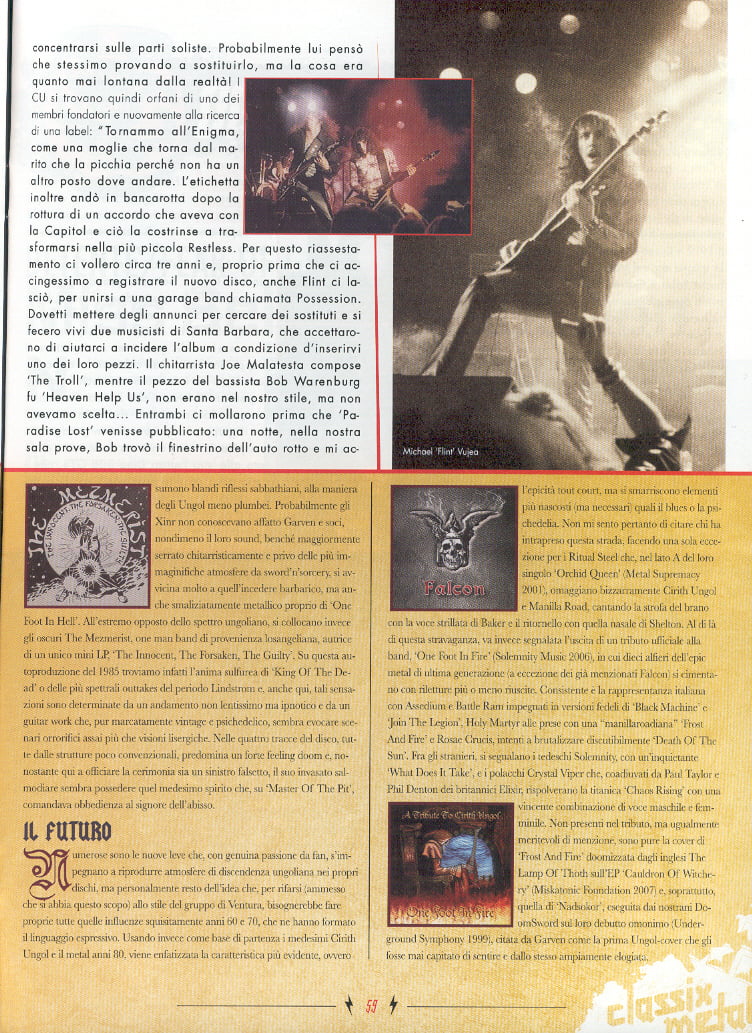
“…to focus on the solo parts. He probably thought we were trying to replace him, but things were quite different in reality.
Cirith Ungol suddenly found themselves without one of their founding members and once again searching for a label: ‘We went back to Enigma, like a wife returning to a husband who beats her because she has nowhere else to go.’ The label soon went bankrupt after breaking its deal with Capitol, which forced it to scale down into the smaller Restless.
This restructuring took about three years, and just as we were preparing to record the new album, Flint left too, joining a garage band called Possession. We had to place ads looking for replacements and saw various musicians from Santa Barbara, who agreed to help us finish the album on the condition that one of their songs be included. Guitarist Joe Malatesta wrote ‘The Troll,’ while bassist Bob Warenburg contributed ‘Heaven Help Us.’ They weren’t really in our style, but we didn’t have much choice. Both left before Paradise Lost was released: one night, in our rehearsal room, Bob found the window of his car smashed and my equipment…”
(continuation of analysis and commentary section)
“…echoing faint Sabbath-like tones, in the style of Ungol but less raw. Probably the members of Xir didn’t know Garven at all, yet their sound is strongly rooted in tightly wound guitar work and lacks the darker, more epic atmospheres—remaining closer to barbaric metal, though more melodic than One Foot in Hell.
At the opposite end of the spectrum compared to the Ungolian style are the dark The Mementos, an English band that released only one LP, The Innocent, The Forsaken, The Guilty. On this 1985 production, guitarist Janina Miller (formerly of King of the Dead-era lineups) and Lindstrom create structures that, although built on very classic riffs, are enriched by a more melancholic feel.
THE FUTURE
Numerous new bands, driven by genuine fan passion, are trying to recreate Ungolian atmospheres in their own albums, but often the idea remains only partially developed. Using the Ventura band’s style as a starting point, one could easily bring together all those influences synthetically.
By adopting the same foundations as Cirith Ungol and 1980s metal, the most evident characteristic is emphasized—namely the epic tout court, but often missing the more unusual elements tied to their blues roots. It doesn’t make much sense, therefore, to cite bands inspired by the more straightforward side of the group.
Returning instead to those who drew inspiration from the most obscure facets, one finds Ritual Steel, who in their single Orchid Queen (Metal Supremacy, 2001) pay a rather bizarre tribute to Cirith Ungol and Manilla Road, closing their album with Baker’s shrill vocals and the title track reminiscent of Shelton.
Among the most recent acts, it’s worth mentioning the debut album of the Swedish Falcon (released in 2006), one of the few representatives of a new generation that, aside from the pioneers Falcon, still seems to struggle to fully immerse itself in this kind of music.
There are also the Italians Doomsword, who debuted with Under the Northern Sky (1999), explicitly citing Garven as a major influence, and whose approach clearly shows how deeply rooted Cirith Ungol’s legacy remains…”
(page 60):
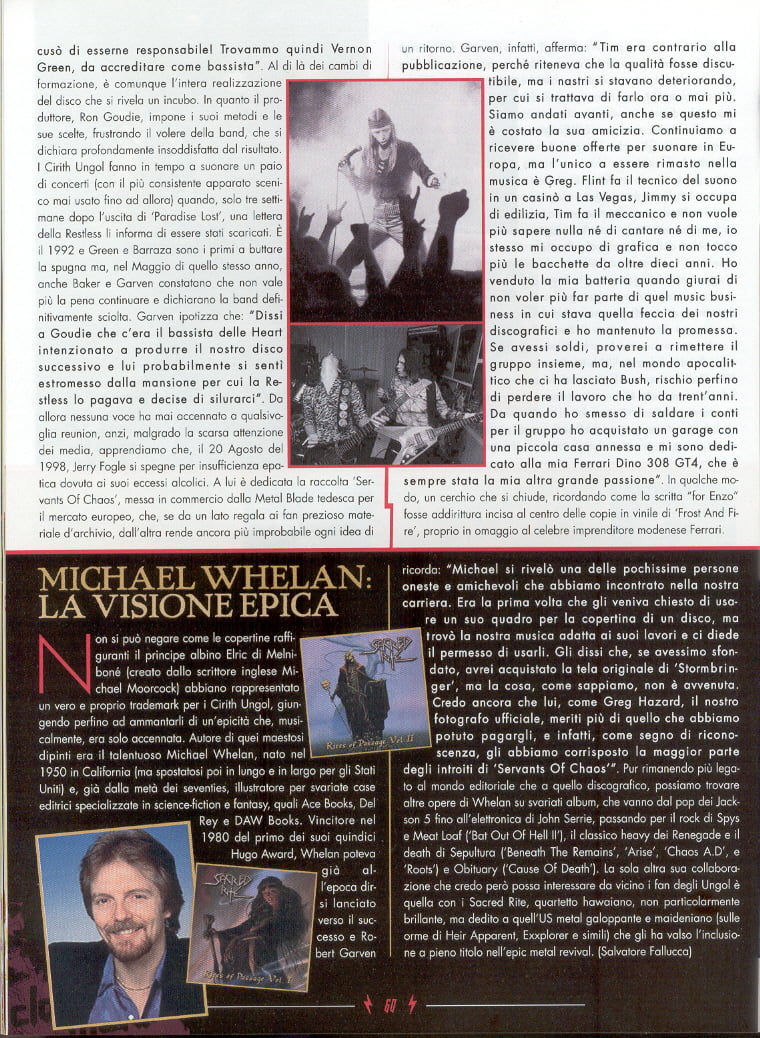
…accused of being responsible. We then found Vernon Green, to be credited as bassist. Despite the lineup changes, however, the making of the album turned into a nightmare. Producer Ron Goudie imposed his own methods and choices, frustrating the will of the band, which declared itself deeply dissatisfied with the result.
The Cirith Ungol only manage to rehearse a couple of concerts (with the most consistent lineup ever used up to that point) when, just three weeks after the release of “Paradise Lost”, a letter from Restless informs them that they have been dropped. In 1992, Green and Barraza are the first to throw in the towel, followed in May of the same year by Baker and Garven, who realize there is no longer any point in continuing and officially declare the band disbanded.
Garven hypothesizes: “They told Goudie that the bassist from Heart intended to produce our next album, and he probably felt cut out of the deal and decided to take revenge. From that moment on, no one mentioned anything anymore; instead, despite the lack of media attention, we learned that on August 20, 1998, Jerry Fogle died of heart failure caused by his alcohol abuse. The collection ‘Servants Of Chaos’, released on Metal Blade in Europe, on one hand gives us a precious archive collection, but on the other makes any idea of a comeback even more unlikely.”
Garven also states:
“Tim was against releasing it, because he thought the quality was questionable, but our situation was deteriorating, so it was now or never. We moved forward, even if this meant ending our friendship. We continued to receive good offers to play in Europe, but I was the only one who stayed in music. Flint became a sound technician in a Las Vegas casino, Jimmy worked in construction, Tim became a mechanic and no longer wanted anything to do with singing or me, and I moved into graphic design and hadn’t touched drumsticks for ten years. I sold my drum kit when I decided I no longer wanted to be part of that music business that had taken away the earnings from our records and I kept that promise. If I could go back, I’d try to keep the band together, but in the apocalyptic world Bush left us in, I risk losing the job I’ve had for thirty years. Since I started handling the band’s finances, I bought a garage and a small house, and I’ve always had another great passion: my Ferrari Dino 308 GT4.”
He laughs, recalling that the phrase “for Enzo” was even engraved in the center of the vinyl copies of “Frost And Fire”, as a tribute to the famous Modenese entrepreneur Ferrari.
MICHAEL WHELAN: THE EPIC VISION
There’s no denying how much the refined covers painted by the albino prince Eric of Melniboné (created by the English writer Michael Moorcock) contributed to Cirith Ungol’s trademark, pushing them to wrap themselves in an epic musical atmosphere, even if only hinted at.
The author of those masterpieces is the talented Michael Whelan, born in 1950 in California (but raised largely in the United States abroad), who since the mid-1970s has illustrated for various publishing houses specializing in science fiction and fantasy, such as Ace Books, Del Rey, and DAW Books. Winner in 1980 of his first of fifteen Hugo Awards, Whelan, already at the height of his career, launched himself toward success thanks to Robert Garven.
Garven recalls:
“Michael turned out to be one of the few truly honest and friendly people we met in our career. The first time we asked to use one of his paintings for an album cover, he looked through our music catalog and gave us permission to use them. I told him that if we had made it big, I would have bought him the original painting of ‘Stormbringer’, but as we know, that didn’t happen. I think Greg Hazard, our official photographer, deserves credit for what we managed to pay him; in fact, as a token of gratitude, we gave him most of the profits from ‘Servants Of Chaos’. To stay more loosely in the world of covers like the ones we’re discussing, we can also mention Whelan’s other works, which have appeared for Jack 5 in the ‘Hellfornication’ series, as well as for rock acts like ‘Meat Loaf’ (‘Bat Out Of Hell II’), the classic heavy of ‘Sepultura’ (‘Beneath The Remains’), ‘Artillery’ (‘Chaos A.D.’, ‘Roots’), and ‘Obituary’ (‘Cause Of Death’), the latter his only collaboration that I believe might interest Cirith Ungol fans, along with ‘Sacred Rite’, a Hawaiian quartet not particularly brilliant but dedicated to that US metal paired with Iron Maiden-style melodies (‘Surf Nicaragua’, ‘Apparent Explorer’ and similar works that have also fueled the epic metal revival).”
(Salvatore Flauccio)
- Abe Books
- Amazon
- Barnes & Noble
- CD Universe
- CDandLP
- Discogs
- eBay
- F.Y.E.
- iTunes.com
- Sonic Age Records
- Tradera
- Walmart
- YesAsia
These links are auto-generated. If you know of a better place to buy Classix Metal #2 April 2009, please leave a comment or post it in the forum.