| π Date | Wed 28 Jul 1976 |
|---|---|
| Present | State Parks and Recreation Department, Pierpont Bay Jam II, The Ventura Parks and Recreation Department |
| π£ Active | played |
| ποΈ Venue | Ventura State Beach Park |
| π Address | San Buenaventura State Beach 901 San Pedro St, Ventura, CA 93001 β |
| Google Maps | |
- π Copy short link
- ποΈ Ventura State Beach Park
- π Back to Venues
- π Back to Gig
- « San Fernando Valley | Up The Hammers Warm Up Show @ Kyttaro Live Club, Athens Greece »
- π Ciriths Google Maps
- β οΈ Add, Edit or Remove your item
- πΊοΈ Old Cirith Ungol Webpit
- π Free concert in Ventura State Beach Park (DuckDuckGo search or Google search or WP search or FB)
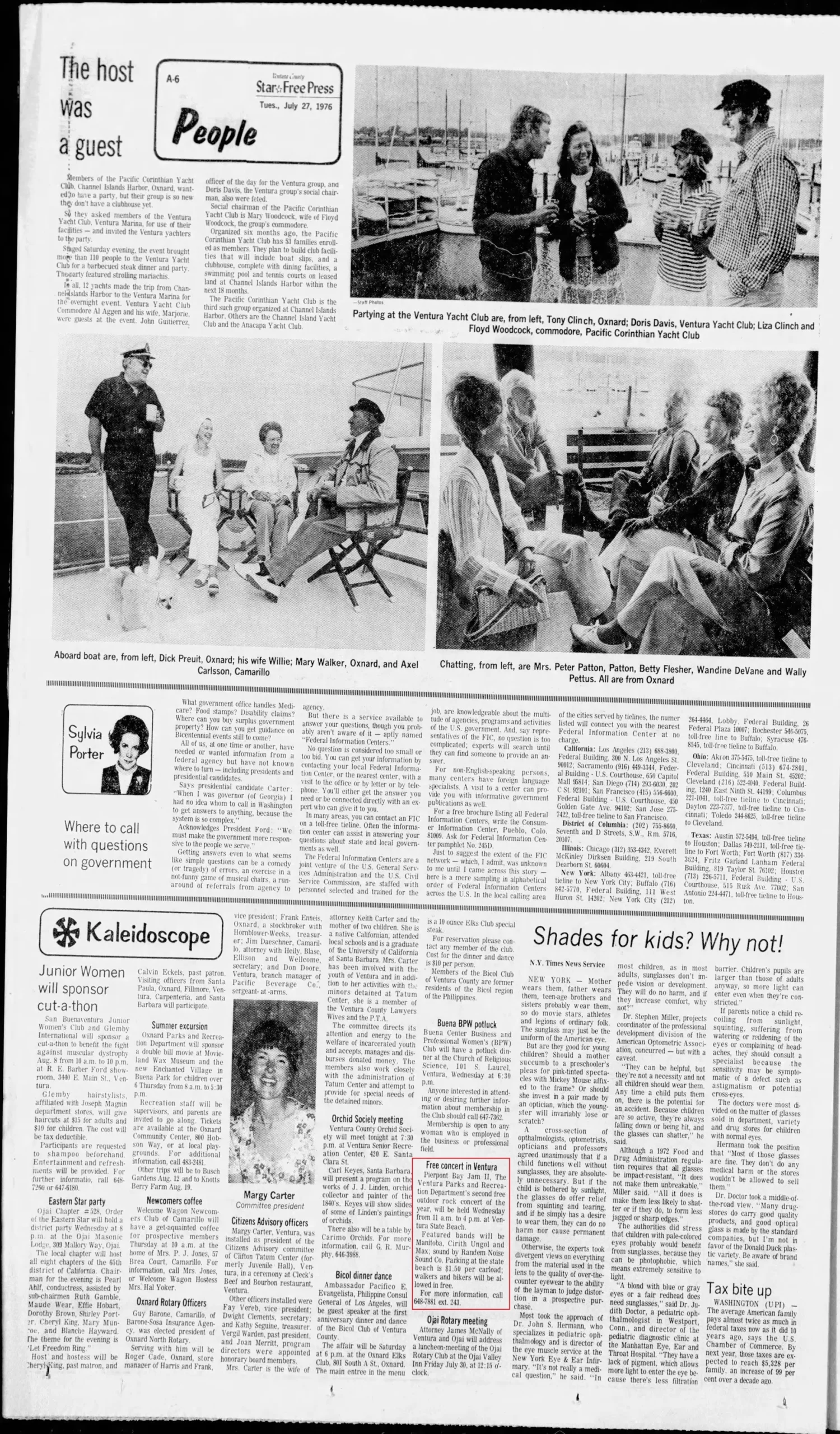
A newspaper article in Ventura County Star Press from 1976. Photo is of the first singer Neal Beattie.
The concert at Ventura State Beach Park. Not sure about the date of concert, Thu 29 Jul 1976 or before. On the picture, it seems Wed 28 Jul 1976, and paper is Thu 29 Jul 1976.
Performed by Glacier (not the more known 1980’s Portland band), Cirith Ungol and Manitoba (from “Music, but no mob…”) or Manitoba, Cirith Ungol and Max (from “Free concert…”). Sound by Random Noise Sound Co.
Old Cirith Ungol Webpit 1, Old Cirith Ungol Webpit 2
What is the setlist for all of the bands? What are the members then? Do you have photos, music or video that we can see or hear? Any more fun facts at that time? What is the short story around the scene, or what is the link to Glacier, Max and Manitoba? Is Glacier on live, or Max on live or both? Different concert? And which newspapers has published and photo of Neal Bettie? Most likely it is not “Ventura County β Star*Free Press” (Tue 27 Jul 1976).
- Ventura County β Star*Free Press (Tue 27 Jul 1976)
-
Ventura County β Star*Free Press (Tue 27 Jul 1976)
Free concert in Ventura
Pierpont Bay Jam II, The Ventura Parks and Recrea- tion Department’s second free outdoor rock concert of the year, will be held Wednesday from 11 a.m. to 4 p.m. at Ventura State Beach. Featured bands will be Manitoba, Cirith Ungol and Max; sound by Randem Noise Sound Co. Parking at the state beach is $1.50 per carload; walkers and bikers will be allowed in free. For more information, call 648-7881 ext. 243.
-
Ventura County β Star*Free Press (Thu 29 Jul 1976)
Music, but no mob at beach
If the sky was clouded, the crowd small, and the music less than ear-shattering, it was still a free outdoor concert, and those who went seemed to have had fun.
The concert at Ventura State Beach Park featured three bands, Glacier, Cirith Ungol, and Manitoba, who entertain- ed the crowd that trickled in throughout the afternoon.
State Parks and Recreation Department sponsors had hoped for a larger turnout than the 100 or so persons who had showed up by 1:30 p.m., but they said the response was probably due to the weather-cool and cloudy-as well as late publicity for the concert, which had been postponed from the previous week.
But no one seemed to mind the small- ness of the event.
For a while the big attraction was expected to be a promised strip act by Neal Beattie, Cirith Ungol’s singer. The disrobing failed to take place, however, because a parks and recreation official told Beattie they would prefer he keep his clothes on.
Photo by Gary Phelps, Travis Jones, 6, foreground, and Willy Kemp, 12, Ventura, watch singer Neal Beattie Wednesday
-
Which newspaper this has published?
Date: Wednesday, (d, Nov/Dec) 1976?
PERHAPS YOU accuse me of exaggeration. I must agree with you, only in the extent of such an extensive computer system. But similar ones exist in the use of household appliances. This seems quite probable.
At this moment, large corporations are utilizing computers to perform secretarial tasks. The most efficient use of personnel, money, and ideas could only be achieved with mini-computers programmed for virtually the same functions. After all, a television remote control unit is nothing more than a simple computer.
As in regard to music, technology is playing an equally pivotal role. A comparison of music recorded in the fifties, in the sixties, and in the seventies reveals an obvious progression. Even in the most modern of times, studio production techniques become so improved that tour de force like βTubular Bellsβ with its zillion overdubs can be created by one man.
If multiple tracking is one significant improvement, then the overall quality of the music is another. Rock music no longer sounds like it was recorded in some cavernous basement. Crystal clarity and audio contrast have deposed the tyrant, distortion.
Furthermore, such nifty effects as phase shifting, reverberation, echo, and feedback can be applied. Together, these items make for a world of music livelier and more varied than ever before.
Studio magic comes in other forms as well. Monophonic became stereophonic which now coexists with quadrophonic. Instead of the same exact music coming from each speaker, different parts of the whole sound are now emitted by each. The result is music with added depth and greater presence.
TECHNOLOGICAL advances, however, have not been limited to the studio. In the past ten years, an instrumental revolution of such enormous magnitude has taken place that musical history will undoubtedly record it with extreme awe.
In 1968, Mike Pinder of the Moody Blues popularized the mellotron, a keyboard instrument capable of duplicating different sounds that previously only an orchestra could produce. This machine, which works via tape loops that are activated by the keys and selector switches, was originally hailed by the musical community. It was feared that mellotrons might make symphonies obsolete. Obviously and fortunately, this never came to pass, and small ensembles like rock groups are free to sound like much larger aggregates.
Right on the heels of the mellotron was the moog synthesizer, a keyboard computer so named after its inventor Robert Moog (rhymes with vogue). Basically it involves the selection of notes and how they can be shaped for various effects by other electronic impulses.
Two of the synthesizerβs earliest and most visible practitioners were rockβs Keith Emerson and Rick Wakeman. The latterβs album βSix Wives of Henry VIIIβ and Emersonβs βSwitched-On Bachβ are two of the best known synthesizer records ever heard around the world.
There are now polyphonic synthesizers on which chords can be played. (One note at a time used to be the maximum.) Some more expensive systems that can be played like a guitar, without any such restrictions, have been invented. Literally any sound can be recreated. There are synthesizers now with a musical potential of over a million different sounds. And there are synthesizers for wind and stringed instruments being used as well.
The latest keyboard instrument is the orchestra. In a similar context to the mellotron, except that instead of tape loops, the music is stored on metal discs which are magnetically laser beams which, in turn, are triggered by the keys and selector switches. With fewer moving parts, the orchestra
β once the bugs are being ironed out β might eventually supplant the less dependable mellotron.
ALL OF THE ADVANCES mentioned above have occurred in the past decade. Trying to imagine another 25 years of progress is like predicting who will win the 2000 election. Who knows?
Someone might invent a brain wave scanner that immediately translates a composerβs ideas into music. Someone might discover a mathematical formula that will lead to the perfect melody, the one nobody will be able to stop whistling. Someone might even set musical scales for different colors. These are now being used. Some physicians might explore music for its therapeutic value. Some scientists might attempt to use music as a means for communicating with extra-terrestrial beings. Who knows?
ONE THING, however, can be concluded with absolute certainty: Music will never lose its entertainment value. And almost as certain is the marriage of video images to music. In the psychedelic sixties, many bands performed their music on stage with four-light shows. In the seventies, they have been replaced by lasers, slides, film clips and other visual effects. They add another dimension to the concert experience, not only enhancing the entertainment side of things, but also underscoring whatever meaning the artist might be contained in the music. Without a doubt, the most splendid example of this multi-media approach was Genesisβs βThe Lamb Lies Down On Broadwayβ tour in 1975.
There is no reason, however, for this approach to be restricted to the stage in the future. By 2000, albums as we know them will probably be relics of another era. We will walk into a music store, purchase the video record of our choice, take it home, and insert it into a modern playback component. A tape head will transfer the music from soundtrack to speakers, and a viewing screen will light up with the accompanying images.
Weβll have something to see, and hear.
But what will the music of 2000 be like? Trends come and go so quickly that one is bound to be full of surprises. All that can be said with assurance is that not even in 1995 will anyone know what they will be.